Blog #12: What surprised you from the worm's dissection?
For the worm dissection, me and my partners discovered a lot. We cut open the worm and observed the inside, which sort of looked quite like the outside. I was surprised that there really wasn't anything in there. However, I found it surprising that there was dirt inside, which looked like black chunks. I didn't know that worms had dirt inside their body, even though they are pretty dirty organisms. Also, I was surprised that the worm had so many segments. I never noticed before, but the worms body has around 100 segments, depending on the size of the worm. For my earthworm, it had 96 body segments, which we counted individually. I also used to think that worms were slimy even when they were dead, but turns out, the earthworm was actually very dry and wrinkly looking. Although I learned alot from this dissection and got to see the inner parts of the worm, I'm glad we won't be doing a worm dissection anytime soon.
Thursday, April 28, 2011
Thursday, April 21, 2011
Blog #11
Blog #11:
Get a picture of alternation of generations. Put it in your blog and explain how it relates to plants.
"Plant life cycles have two phases known as the alternation of generations. The sporophyte phase is "diploid" in the picture, and is part of the life cycle in which meiosis occurs. The gametophyte phase is "haploid", and is the part of the life cycle in which gametes are produced. In flowering plants the multicelled visible plant such as a plant leaf is sporophyte, while pollen and ovaries contain the male and female gametophytes. Plant life cycles differ from animal ones by adding a phase, the haploid gametophyte, after meiosis and before the production of gametes.
Alternation of generations is normally used to describe the life cycles of plants. Organisms such as fungi can have life cycles in which different kinds of organism alternate. The term 'alternation of generations' has been applied to these cases."
Thursday, April 14, 2011
Blog #10
Blog #10:
Why is dissection an important part of a biology curriculum? Which animals and/or plants should be included in biological studies?
Dissection is an important part of the biology curriculum, because it allows students to have hands-on experience with animals or plants, which is especially important for students who are interested in pursuing the medical field as a surgeon or someone like that. A lot of important information about the environment can be discovered through the examination of the dissected animals' organs and tissues. Science education is a process of exploring different experiences, like dissecting animals, that may lead students into a future profession.
An animal that should be included in biological studies is the frog. The frog is probably the most popular species that students dissect, in different schools around the world. Classroom often use frogs because they can be easily caught, and are small; frogs also have about the same organs as a human. Research scientists dissect frogs to see what effects pollution and climate change are having on frogs. The reason for this is because of the fact that frogs are a lot more sensitive to environmental changes and will show effects much earlier than other species, such as human beings.The dissection of the fetal pig in the labratory is also important because pigs and humans have the same level of metabolism and have similar organs and systems. Even better, fetal pigs are usually inexpensive and easy to buy.
Why is dissection an important part of a biology curriculum? Which animals and/or plants should be included in biological studies?
Dissection is an important part of the biology curriculum, because it allows students to have hands-on experience with animals or plants, which is especially important for students who are interested in pursuing the medical field as a surgeon or someone like that. A lot of important information about the environment can be discovered through the examination of the dissected animals' organs and tissues. Science education is a process of exploring different experiences, like dissecting animals, that may lead students into a future profession.
An animal that should be included in biological studies is the frog. The frog is probably the most popular species that students dissect, in different schools around the world. Classroom often use frogs because they can be easily caught, and are small; frogs also have about the same organs as a human. Research scientists dissect frogs to see what effects pollution and climate change are having on frogs. The reason for this is because of the fact that frogs are a lot more sensitive to environmental changes and will show effects much earlier than other species, such as human beings.The dissection of the fetal pig in the labratory is also important because pigs and humans have the same level of metabolism and have similar organs and systems. Even better, fetal pigs are usually inexpensive and easy to buy.
Thursday, April 7, 2011
Blog #9
Define the different forms of community interaction: competition, commensalism, mutualism, predation, parasitism. Give an example and a picture for each.
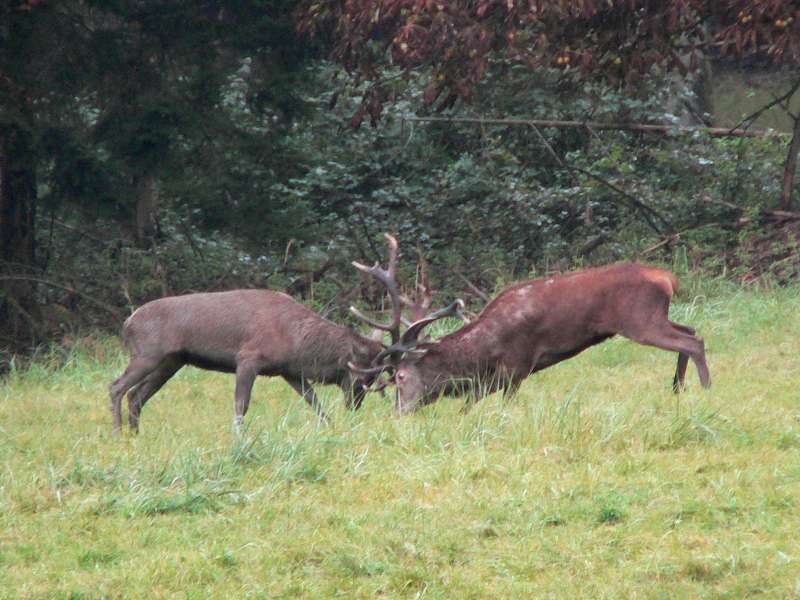
One type of community interaction is competition. Competition is an interaction between species or organisms and the fitness of one is lowered by the presence of the other. Competition can occur when the species are competing in the same area for a limited food supply or when they must share limiting resources. Species less suited to compete for resources either adapt or die out. An example of competition is in the picture below, which shows two male deer competing during mating season.
Another type of community interaction is commensalism. Commensalism is a relationship between 2 organisms where one organism benefits from the other, but the other organism is not harmed but also does not benefit from the relationship. An example of commensalism is like the relationship between the sun and the plants. The plants benefit from the sun's sunlight, but the sun does not benefit from the plants, nor is it harmed by the plants.
Mutualism is the relationship between two organisms, where both organisms benefit from each other. An example of mutualism would be like birds flying in formation. They all benefit from each other. When the leading bird gets tired, it flies to the back of the formation and the next bird takes over. They continue this and benefit from this because they can fly longer and farther in formation.
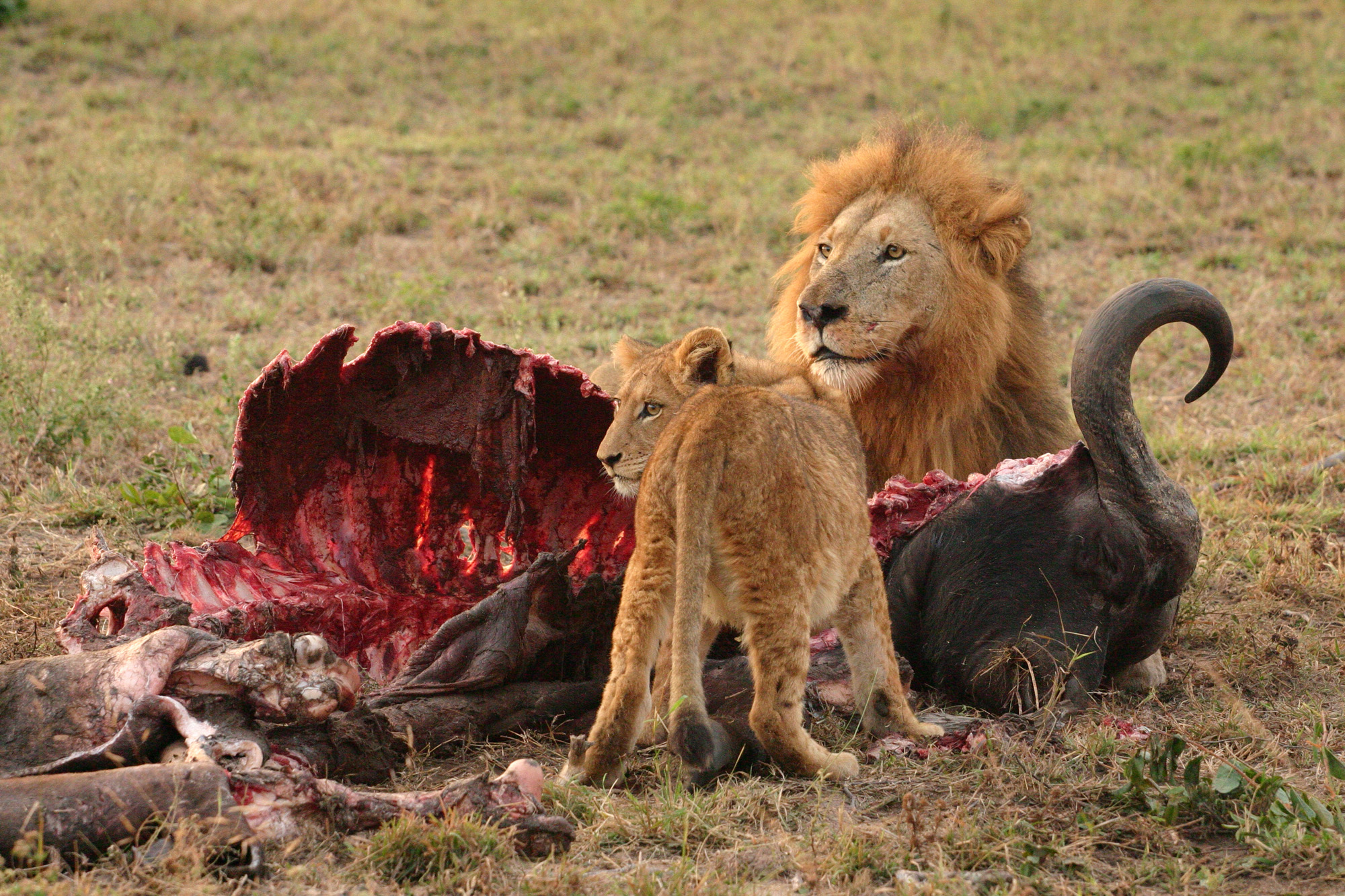
Predation is an interaction between organisms where the predator feeds on its prey. The act of predation always results in the death of its prey and the eventual absorption of the prey's tissue through consumption. An example of predation would be like a lion, the predator, feeding on a Cape Buffalo, the prey, shown in the below picture.
The last type of community interaction is parasitsm. Parasitism is a type of symbiotic relationship between organisms of different specieswhere one organism, the parasite, benefits at the expense of the other, the host. An example of parasitism is like fleas on a dog. The fleas won't kill the dog, but the dog will have to be cleaned and treated.
Thursday, March 24, 2011
Blog #8
Blog #8: Your choice: Talk about something you learned or ask a question about something that is confusing you.
Something I learned about recently is about the food pyramid, which I had to research in my previous blog. I thought I knew about the food pyramid before, but I learned a lot of new things about it. A few years ago, there was an old food pyramid, which showed that proteins was the most important part of the pyramid. This led to obesity in many people, because everyone thought that they could eat a lot of proteins and carbs, like bread. However, no one really understood the food pyrimid serving sizes, so they ate according to the pictures, which weren't always accurate. After all, they were just pictures, and the important thing was learning what to eat, and how much to eat it. So, in 2005 a new food pyramid was created, making the fruit and vegetable part of the pyramid more important to our health. It showed better ways to eat healthy.
Thursday, March 17, 2011
Blog #7
Blog #7: Compare and contrast two biomes. Describe them in detail; include pictures of plants and animals you are likely to see.
The Freshwater Biome accounts for one fifth of Earth and provides half of the drinking water, one third of the water used for irrigation, and nearly ninety percent of the world's bathwater. The biome consists of inland lakes, streams, brooks, creeks, rivers, ditches, sloughs, gutters, puddles and canals. Leeches and catfish are a few of the many animals that the Freshwater Biome supports.
Source: http://www.idiotica.com/cranium/encyclopedia/content/Freshwater.htm
The Marine Biome are consisted of marine regions, coral reefs, estuaries, and oceans. This is similar to Freshwater Biomes because they both contain bodies of water, but Marine Biomes cover more of Earth's area, about 3/4 of Earth's surface, opposed to Freshwater Biomes which cover only 1/5 of Earth's area.
Source: http://www.ucmp.berkeley.edu/exhibits/biomes/marine.php
The Freshwater Biome accounts for one fifth of Earth and provides half of the drinking water, one third of the water used for irrigation, and nearly ninety percent of the world's bathwater. The biome consists of inland lakes, streams, brooks, creeks, rivers, ditches, sloughs, gutters, puddles and canals. Leeches and catfish are a few of the many animals that the Freshwater Biome supports.
Source: http://www.idiotica.com/cranium/encyclopedia/content/Freshwater.htm
The Marine Biome are consisted of marine regions, coral reefs, estuaries, and oceans. This is similar to Freshwater Biomes because they both contain bodies of water, but Marine Biomes cover more of Earth's area, about 3/4 of Earth's surface, opposed to Freshwater Biomes which cover only 1/5 of Earth's area.
Source: http://www.ucmp.berkeley.edu/exhibits/biomes/marine.php
Wednesday, March 9, 2011
Blog #6
Blog #6 Which level of the food pyramid is the most important? Support your answer.
In my opinion, fruits and vegetables are the most important level of the food pyramid. Although people can argue that proteins is the most important, fruits and vegetables can't make you overweight or unhealthy if you eat more than the recommended portion. When the new food pyramid wasn't created yet, people were going by the old food pyramid, which had proteins as the biggest and most important part of the food pyramid. That led many Americans to obesity, which is why the new food pyramid was created: to help people better understand how many servings of each level they should be eating. Fruits and vegetables are most important because they contain carotenes, which enhance our immune systems and helps against diseases. Fruits and vegetables also provide fiber, nutrients, minerals and vitamins, such as Vitamin A, which is good for eyesight and growth, and Vitamin C, which is good for protection against viruses and bacteria and healing wounds.
Sources: http://www.netdoctor.co.uk/health_advice/facts/vitamins_which.htm
http://pediatrics.about.com/od/foodpyramid/a/05_food_pyramid.htm


In my opinion, fruits and vegetables are the most important level of the food pyramid. Although people can argue that proteins is the most important, fruits and vegetables can't make you overweight or unhealthy if you eat more than the recommended portion. When the new food pyramid wasn't created yet, people were going by the old food pyramid, which had proteins as the biggest and most important part of the food pyramid. That led many Americans to obesity, which is why the new food pyramid was created: to help people better understand how many servings of each level they should be eating. Fruits and vegetables are most important because they contain carotenes, which enhance our immune systems and helps against diseases. Fruits and vegetables also provide fiber, nutrients, minerals and vitamins, such as Vitamin A, which is good for eyesight and growth, and Vitamin C, which is good for protection against viruses and bacteria and healing wounds.
Sources: http://www.netdoctor.co.uk/health_advice/facts/vitamins_which.htm
http://pediatrics.about.com/od/foodpyramid/a/05_food_pyramid.htm
Subscribe to:
Posts (Atom)